
BLISS RATING: ★★★★+
“If you wear a mask for too long, there will come a time when you cannot remove it without removing your face.” – Matshona Dihliwayo
Sometimes situations are described as a Labor of Love. This was a Labor of Lost Love in two ways, really. The story itself is lost. Its premise requires a stretch to believe, yet it remained verisimilar. Let me explain.
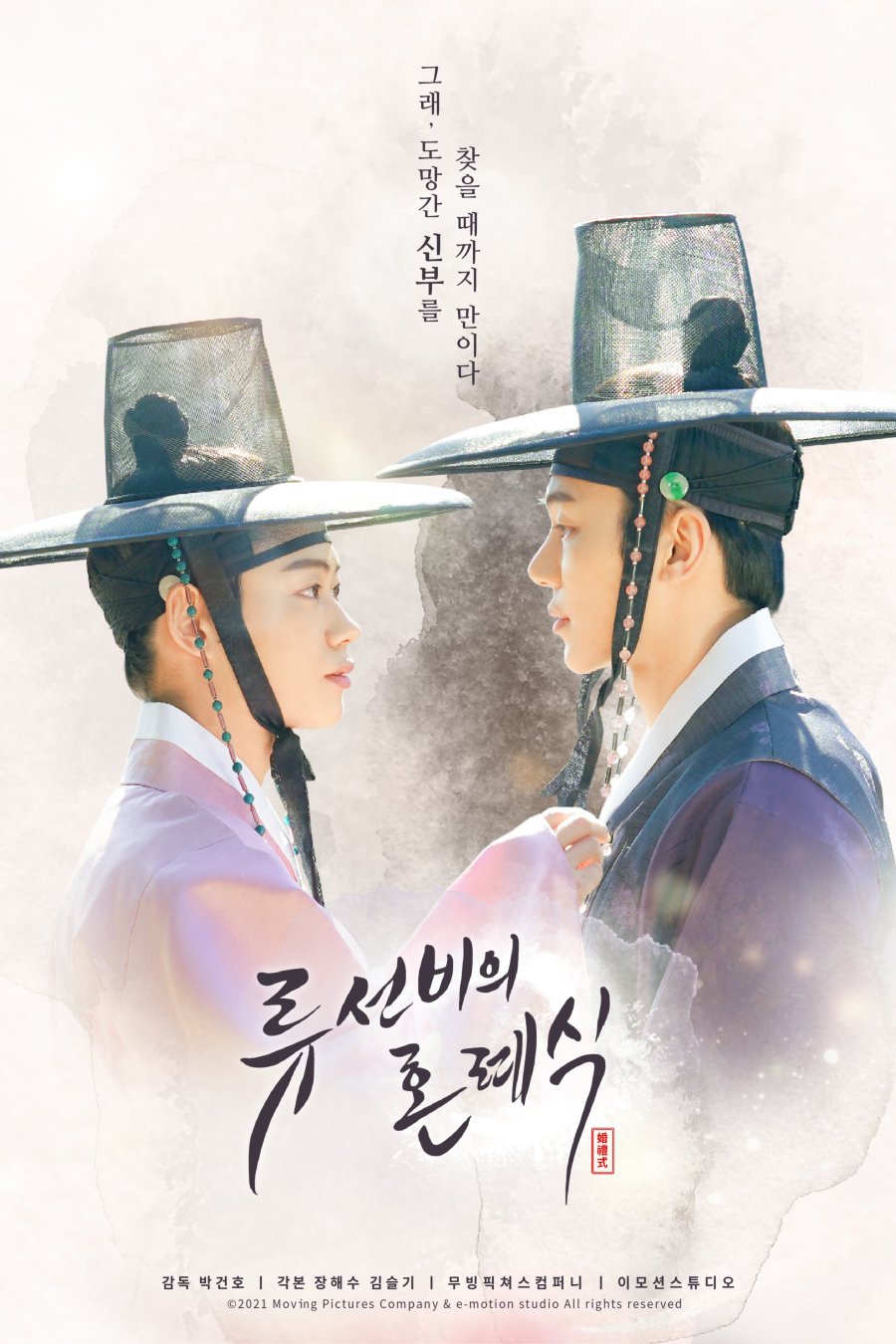
Basically, the brother, Choi Ki Wan (Lee Si Jin), takes the place of his sister in an arranged marriage. Since the fiancée, Ryu Ho Sun (Kang In Soo), had not met her before, he does not realize until after they are married that Choi Ki Wan is a male. He explains that he is standing in her behalf to save face for his family and to preserve Ryu Ho Sun reputation and honor as well.
His sister simply panicked and got scared and therefore ran away. I know this sounds strange, but I found that whole process charming. First, he looks female and could pass for female. Second, during that period of time, the Joseon Dynasty, this switch would have been unthinkable so therefore, it could have worked in the short run. It would not have even crossed anyone’s mind that this egregious act could be pulled off. Third, after finding out, Ryu Ho Sun could have taken several different actions to not play along with this sham but did not. So, underlying this, is the fact that he liked this arrangement as he found Choi Ki Wan beautiful (which he absolutely is).
And as the relationship blossoms because of familiarity, you can see Ryu protects, supports, encourages, and see Choi as his ‘wife’ and rather enjoys it. He is gentle, soft, and tender with his dealings with his wife. While I must confess my knowledge of Korean history is nil, the fact that they played their parts so well felt real and nature as if what a real married couple would have done. Even others began to see them as a married couple.
A curious Red Herring is thrown into this series that at first seems superfluous or even gratuitous, yet it is not. Kim Tae Kyung (Jang Eiu Soo) comes to visit his friend Ryu Ho Sun. He is struck by Choi Ki Wan’s beauty, and he tries to woo her (him) from Ryu Ho Sun. Obviously, he is not understanding the complete picture and of course is rejected but not because of a lack of trying. Honestly, Choi Ki Wan is stunningly beautiful be it male or female. Kim Tae Kyung will eventually play an important role in getting Choi Ki Wan to see for himself what is obvious between him and Ryu Ho Sun.
Eventually the sister, Choi Hwa Jin (Cha Soo Jin) returns and the contrived marriage must now come to an end. Three outcomes are realized by her return. One is this ‘relationship’ must end but not without a lot of pain and heartache suffered by both. It is the wrong time and the wrong gender. Choi Ki Wan is more cognizant of this point than Ryu Ho Sun is. Ryu Ho Sun literally, in a stylish oration, essentially confesses his wanting to be with him before he leaves. Softly. Matter-of-factly, with just a whisper of tears. But the reality was that there was no further path to express their love for each other. The pain I found to be real. “There is nothing we can do”, he states as he leaves Ryu Ho Sun. Two, Ryu was not willing to substitute the sister to continue the marriage. Of course, there was the elegant reasoning behind it but for me it went much deeper. I found it to be that he finally found his love and anything else would be an inadequate substitution. Three, when Kim Tae Kyung returns and discovers that Choi Ki Wan is a male, he reinforces that his original feelings for him were genuine but cannot be realized. He was also astute enough to let Choi Ki Wan know that despite his stoic exterior, his connection to Ryu Ho Sun is fated and cannot be broken.
With much soul-searching and now as a hybrid of two people, Choi Ki Wan seeks out Ryu Ho Sun. He quotes Ryu Ho Sun’s mother, “The person who wants to see you more is the one who goes.” Hence, that is why he came back. He also tells him that during their wedding ceremony, they vowed, “Unless one of us returns back to the earth, the relationship cannot be ended.” In his quiet, soft-spoken almost whisper tone, Choi Ki Wan says, “That is why I came back to my rightful place next to you.” This profound statement represented a turning point of great significance. He was willing to give up all to be next to a person that he loved in a time that would be fraught with condemnation, suppression, and perhaps retaliation. I found that to be stunning.
Who really S.T.O.L.E. the series? I gave this nod to Lee Si Jin as Choi Ki Wan. I did this because this role could not have been easy. He had to be female without being cartoonish or over-the-top about it yet do it enough to pass the inspection of the mother and sister. He did not give up his masculinity to be female yet understood what his role had to be and played it with grace and supplication. It was obvious that he did not want to be in this position but did so out of a sense of loyalty to his family and to honor Ryu Ho Sun and under constant fear of being discovered. Perhaps it was a stretch to see him in this role, but I put myself back in that time period and thought would the concept of a male pretending to be a female AND being supported by her ‘husband’ had been unthinkable and therefore not considered a possibility? Yes! I also enjoyed his subtleties in manners, tone, and facial expressions that enhanced the development of their relationship. Ryu, as the man, could be more forthcoming with his feelings, while Choi could not. After all, male love relationships were not sustainable, and he had to be and stay in female character. I found all that intriguing.
The second way this series was a Labor of Lost Love was from its production standpoint. Yes, I would have loved more episodes where we could have seen the relationship develop more and see its intensity. It was also too short, too choppy, and its flow was not always easy to follow. They tried to do too much in too little time. The actors seemed wooden at times and too unemotional. It seemed at time amateurish, and it all felt rushed.
This series touched me in ways I was not expecting. This will not be a series for everyone but for me it worked, and I appreciated its efforts. I liked this series a lot. It is more complex than what it appears to be. It tackles some very difficult issues in too short of a period. The pain and difficulty of being ‘different’ during that period of time is unimaginable and expressions had to be coded in obtuse language and nuances. And this series did that to an effective degree, at least for me.
Its message on me was never lost and I found the execution of that message both interesting and provocative. I found it all to be quite deep and profound and, by the end, I appreciated its efforts.
Leave a Reply