
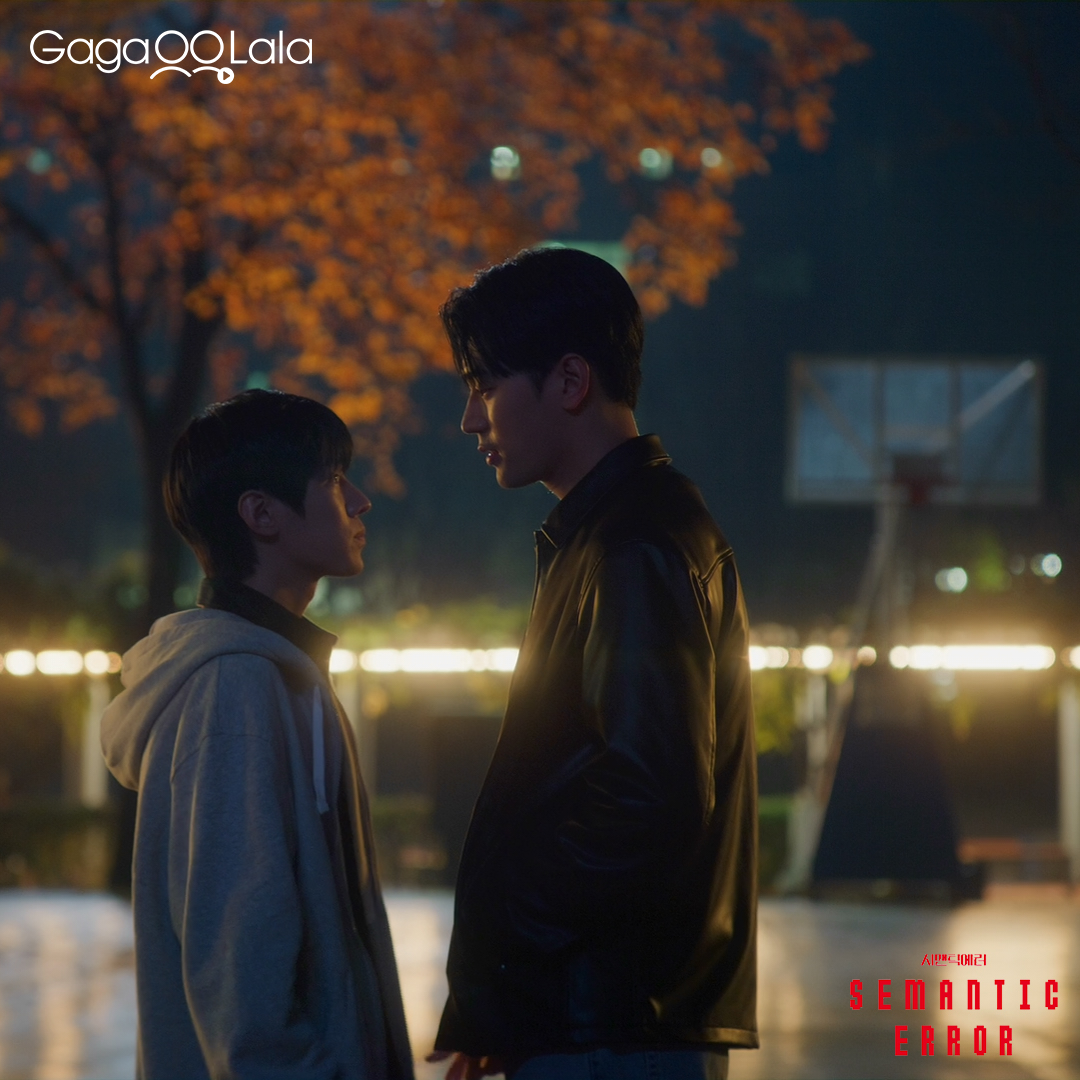
BLISS RATING: ★★★★+
“Semantic Error is a programming error that arises from a misunderstanding of the meaning of some construct in a programming language.“
The initial storyline started out interestingly, but then drifted into an archetypical ending. The story telling and the flow of this series are quite good as well as the overall acting. There are also some shining moments to it that makes it more than watchable, but the series overall seems a bit too rushed. It wrapped up a bit too neatly to be believable. If they finished how they started, it might have been different for me.
It starts out conventionally. A smart, but lazy college student named Jang Jae Young [Jangjea] (Park Seo Ham), is an astonishingly handsome individual who can melt anyone simply with his good looks. While astute, he did not really apply himself to the senior project, which caused him to be held back for graduation for another term. The culprit who snitched on his non-contribution to this project was Chu Sang Woo [Sangchu] (Park Jae Chan), who did most of the work and reported that fact as such.
Sangchu is an enigmatic individual with a boy-next-door look that simply draws you to him. He has an astonishing ability for organization and a gift for order. His entire focus is on completion of projects and a zeal for perfection with a no-nonsense approach. His movements and interactions with others are somewhat robotic. Yet, there is something charming about him even if his personality, mannerisms, and behaviors are almost anti-social. He is pretty much a loner with highly ritualistic behavioral tendencies.
Since Sangchu is seeking a programmer for his project and Jangjea knows he is a good programmer, he applies for the position but is flatly refused by Sangchu. But he begins to torment Sangchu to become his programmer. Initially, he does so to get ‘even’ for what Sangchu did to him in exposing him as a freeloader. So, he quite literally forces himself onto Sangchu. He is relentless and his behaviors border on harassment. He literally tortures him into submission and senses that all of this will break him down since Sangchu has little to no social skills or coping mechanisms to countermand Jangjea. He can feel that Sangchu’s world is being torn apart from this constant bombardment. Reluctantly, Sangchu gives in. However, in a gesture of utter defiance, Sangchu identifies Janghea in his phone contacts as “Freeloader 3” and never changes it.
While the initial interactions between the two are funny, there is a fine line when harassment spills over into bullying and to a degree Jangjea has done that. Some of the antics are childish and immature while others seem hurtful and cruel. During this time, it is obvious that Sangchu is trying to tell him to stop, but Jangjea refuses to listen. Eventually Sangchu lets Jangjea know, through words and obvious hurtful reactions to what he is doing to him what his limitations are. Even Jangjea begins to see and understand that this annoying behavior of his is causing Sangchu a great deal of stress.
It does not take long for Jangjea to develop stronger feelings other than admiration for him, mainly because they spend so much time together but more importantly, he becomes impressed with Sangchu’s complete commitment to what he is doing. Sangchu also manifests feelings for Jangjea but way more surreptitiously. Of course, he continuously denies or tries to deny his feelings for him. But even he becomes enamored with Jangjea not only for his programming skills but also for his physical beauty. In a twist of irony, they begin to understand one another better. At one point within the nonstop bantering between the two, something struck me profoundly and led me to have a significant revelation. When Jangjea touches Sangchu, he recoils, but tells him that if he lets him know in advance, he would be all right with that and indeed accept it.
That is when it struck me! It was the first overt sign that Sangchu really liked Jangjea but more importantly, Sangchu was, perhaps undiagnosed. He is not just an odd character with antisocial skills, but apparently on the autistic spectrum disorder. The typical behavior patterns, the almost religious adherence to routines, the recoiling of being touched, his ritualistic patterns – all lead to one conclusion. He is autistic! Simply being on the autistic spectrum disorder does not always mean a negative intellectual dysfunction, but one surely in social skills. Trying to change his behavior patterns would indeed have a very negative effect on him functioning socially and to force him into changes would be most difficult and challenging. Logically, from that point of realization, the story made more sense to me, and I completely understood Sangchu.
His ability to overcome those ritualistic behavior patterns and thinking patterns made this series feel extra special. Having worked with individuals with Autism for decades, I know how difficult it is to establish a deep connection to someone and how enticing it is to simply retreat into your own world of rigidity to make these feelings go away. For him to overcome that is a sign of significant growth and development. To want to share his life with another, especially one so unorthodox as Jangjae, is mountainous to overcome and in and of itself a remarkable story. In that sense, this story is impactful, but questionable in real life (although not impossible). Of course, if you only see Sangchu as an odd duckling and a misfit, then the story might feel a bit out of synch for you.
Who really S.T.O.L.E. this series? This is a well-acted series with even some strong tertiary characters. Park Seo Ham and Park Jae Chan made a cute and adorable couple. They, I must admit, are good kissers. But I had a hard time seeing them as a genuine couple, especially at the end, when they are finally together. I am not sure this is a ‘match made in heaven’. It all felt just a bit hollow to me. There is no question in my mind who the real star in this series is. It is Song Ji Oh as Choi Yu Na. She is exactly what this series needed. While she is a friend of Jangjea, she understands him better than himself. A no-nonsense individual, who speaks bluntly and with complete honesty. She is wonderfully refreshing. Seemingly arrogant at times, she is hardly that. She is merely hard-hitting and tries to get everyone to see what is obviously right in front of them. Her performance made me laugh, understand, and put into perspective what was going on. She provided the right balance between Jangjea and Sangchu. Hard-nosed at times, she still listens and completely understands. What is obviously a simple filler role, she turned it into such an integral role that this series would not have had such an impact on me. She literally helped me to ‘fill in the blanks’ in what I did not understand in these two. She did so with such toughness, wisdom, and strength of character, I just thoroughly enjoyed her performance. Many kudos!
The screenplay and production output in this series is remarkable. There are some astonishing dialogues between the two main actors. Coupled with great acting, the interactions were some of the best interactions I have seen in any BL series, especially as they were beginning to grow their relationship. Sometime sharp with each other followed by incredibly tender and understanding moments. They made Sangchu’s inner conflicts in trying to break down his walls so vivid and real, especially if you saw him as being on the autism spectrum disorder.
The idea of a two-week trial relationship was a stroke of genius, and it would be something someone with his condition (assuming that he is on that spectrum disorder) would understand not just logically, but emotionally also. There were so many subtleties in language that I truly loved. For example, as Jangjea and Sangchu talk about him going to France, Sangchu says with such sincerity. “Do you think I would be happy if you decided to not go because of me? I am not the stupid protagonist of a romance novel”. When Sangchu is mumbling to himself and thinking whether to try this two-week trial relationship, he literally asks himself if he should try this thing. As he turns around, the message on his sweatshirt in big green letters is the word YES with a big thumbs up. An incredibly amusing stroke of subtleness. This series is replete with these idiomatic expressions throughout. Enjoy them.
However, the one negative aspect to this series is the harassment of Jangjea towards Sangchu especially in the beginning. He wanted to make his life a living hell and I found that to be beneath dignity and incredibly immature. There are more appropriate ways to work out differences with others, especially when you are in the wrong. Whether Sangchu is autistic or not is not relevant. It was cruel and mean-spirited and if you buy into my theory, it reaches a new level of sensitivity for cruelty.
My question to myself is: Why did I just not feel an emotional connection between the two? Honestly, I do not know. The script is great, the actors amazing, support performances spot on and story is good. Perhaps it felt rushed. Perhaps it felt a bit too contrived and formulaic, especially at the end. Or maybe I am seeing these characters, especially Sangchu, wrongly or through my rose-colored glasses having worked with individuals with autism for so many years. If they had finished what they started in making the ending more like the characters – flawed, unpredictable – and not necessarily as stock characters, it might have been more impactful for me. But it is still a good series and worthy of attention. It is entertaining and fun.
Again, I am seeing this series in accordance with what I think Sangchu had. You do not have to accept this hypothesis. If you do not, then your conclusions will undoubtedly be very different from mine.
By the way, in the end, the semantic error became: Clear
Leave a Reply