
BLISS RATING: ★★★+
“Teddy bears don’t need hearts as they are already stuffed with love.” – Anonymous Quote
This is an astonishing series that hits every emotion in our human repertoire except one, ironically. More on that later. Watching this series, since it is so long, almost becomes a part of you and you are left with mixed emotions on how to feel about it and what to think after watching it. It envelopes you in such a way that to say something unflattering is actually painful to do. This series cannot be summarized; it needs to be felt as it is that visceral. Some will be moved to tears, while others will ponder its real meaning, and others will be angry and disappointed. I would not recommend this series for either ‘binge watching’ or if you have an issue with depression or other serious emotional issues. It is a rather intense series and to a degree it glorifies suicide.
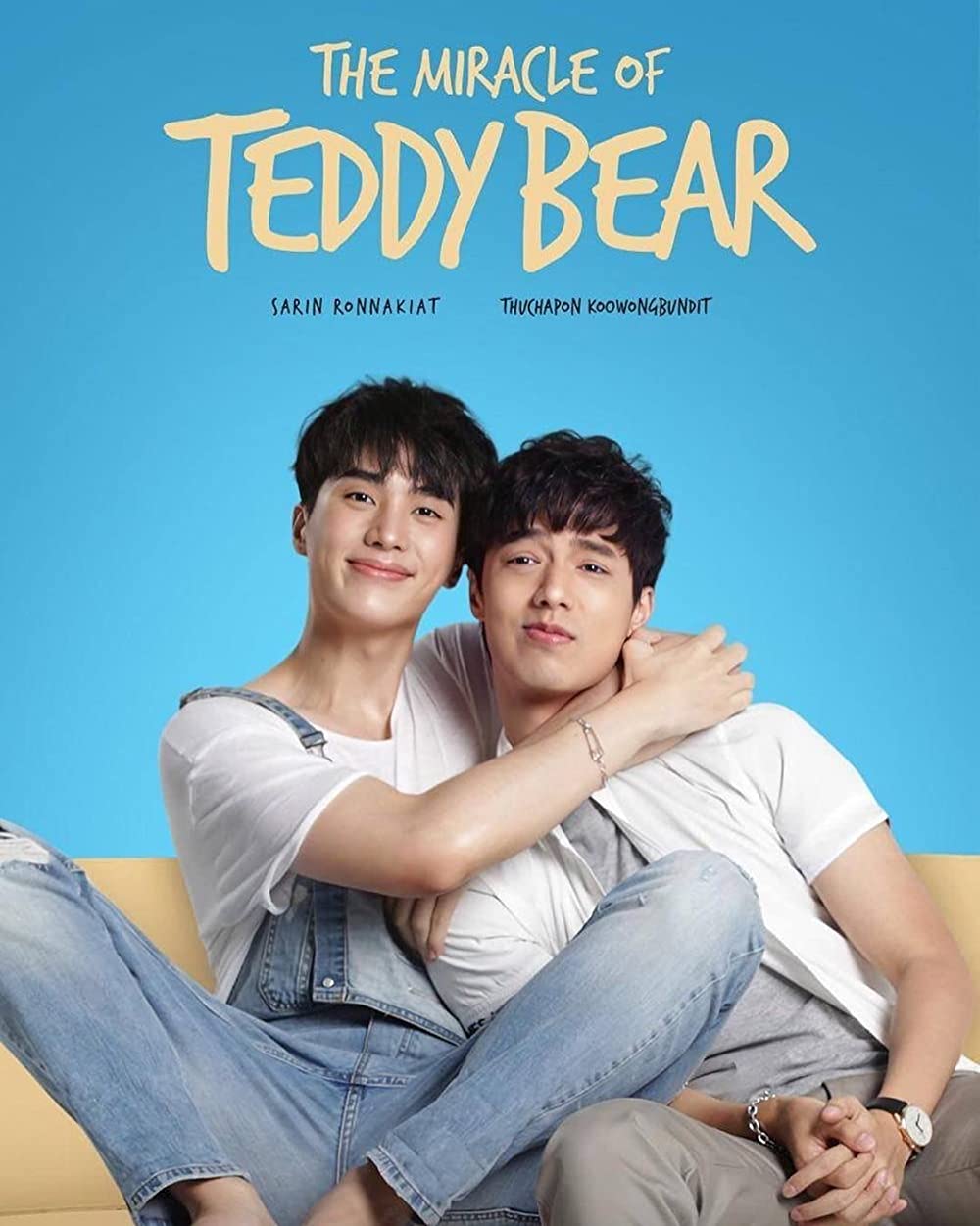
Summarily, this is a mystical and mythical tale of a teddy bear who comes to life. The teddy bear is named, Tofu. His transmogrification to being human is really the story. This transformation’s origins stem from a form of deep love that touches two souls and for the need to make things right. He represents both salvation and remorse. Tofu (Inn Sarin Ronnakiat) has all the credentials of innocence but with the wisdom of reflection, observation, and a keen intellect. He is representative of what it is like to be good, altruistic, kind, thoughtful, devoted, and willing to sacrifice himself for love. In other words, he represents all the qualities we wish we had but do so only in limited quantities and limited qualities. He is what we can never be or ever have. His function is to put us on the right path to happiness and hope we follow it to its natural conclusions.
The object of his deep affection, love, and commitment is Nut (Job Koowongbundit). Nut is a tragic figure of Shakespearean proportions. He has been deeply wounded, emotionally/physically abused, and made to feel less than human by the people who he most admired and trusted. His response has been to turn inward and become angry not only with himself but with all the individuals around him. He is so angry, pathologically speaking. Tofu is the calming effect and the beacon to help him guide his own way out of the tunnel of anger he is lost in. To say that to watch this journey is not a thing of beauty would be a lie. As it is Tofu’s gentleness, warmth, and wisdom that guides Nut to safety, no matter what is thrown at him. His devotion to Nut is akin to a moth being drawn to a flame. It is irresistible with the outcome inevitable.
While Tofu is his guider, the object that Nut heads for is the individual who helped Nut gain an understanding of what life is and an acceptance of who and what he is, Tathan (Judo Tharinpirom). Tathan never wavered in his love for Nut and in a metaphysical way is responsible for the connection between Tofu and Nut. It is his love for Nut that transcends to making Tofu come alive.
Obviously, this story is way more complex and has an almost infinite number of twists and turns to concluding the story. Only one of those plots is really appurtenant to making the story flow with relevance. And that story is about Nut’s mother, Na, played brilliantly and astonishingly by Um Apasiri Nitiphon. In reality, this is as much, if not more, her story as well as it is Nut/Tofus’s story. Her life is laid out for us in all its rawness, pain, grief, and emotional torture in such vivid detail and intensity that it drains you. She represents so many, many individuals whose life is so parallel to hers. We can find something in her life to relate to, mourn about, or feel with intensity. It is an astonishing and brilliant piece of tortured art layered for us to experience. I cried, wept, and felt a deeper emotional connection to her than with any another character in a BL series since Until We Meet Again.
Who really S.T.O.L.E. this series? It should be obvious by now who is the real star in this series. Unquestionably, it is Um Apasiri Nitiphon as Na. The emotional range of her character is not just wide but so intense. Her performance is nothing short of moving. She is the epitome of a loving, caring, giving mother who sacrificed her own happiness for the sake of her family and gave up so much. Her sacrifice is almost unimaginable. And she is repaid back with physical abuse and emotional torture from her husband, intense hostility and anger from her son, and an even crueler response from the fates as she ages. To not be affected by her performance throughout is not a physical possibility. She is not just sad but carried the weight of bone-crushing guilt on her shoulders. All the while, maintaining a sense of dignity, an understanding of what life’ s cards have dealt her, and an acceptance of the reality she lives in. It is a remarkable performance, and she is in all honesty so much of the story, it could have been called, “The Miracle of Na”. A second person worthy of this distinction goes to In Sarin Ronnakia as Tofu. His ability to dart from his reality to the ‘real’ world was flawless and seamless. He made this fantastical character seem so real and never once felt hokey or contrived. He played his part always with a heaviness even when he was happy, as if he knew what the outcome was always going to be for him. His brilliance in not giving in to being pensive and living in the moment was remarkable and should be a lessoned learned for all of us. He always lived with the knowledge his time was limited, as is our own. His whole focus was on paving the way for Nut’s happiness. While he was a pawn, he never gave us the impression he was being used (which tragically he was). It was subtle, soft, reflective, and simply brilliant. Kudos for his performance.
As I have stated there is so much to unpack in this marathon drama. It is overwhelming in what it was trying to do. Perhaps its message could have been better served with far less episodes and better editing with a lot less of a convoluted story. It wondered around a lot. The antagonists were a bit over-the-top and obvious. It went out of its way to dislike them.
The ‘other’ love interest between Gen (First Chutchavalchotikul) and Song (Tee Jarujitranon) was a slow burn to nothingness. It had nothing to do with their acting; they were actually quite good actors. Tee is simply adorable, and his characterization of Song was mesmerizing and endearing. What is bothersome about their relationship is the insufferably long-belaboring development of it that ends up as intimate as tossing salad dressing on a salad. There is no real connection, no chemistry, and certainly no overt signs of love or anything connected to love. Sometimes it seemed like schoolboys discovering themselves for the first time. It is cute but wears thin after a while.
Which brings me to my responding to my original statement. I stated that this series hit every emotion in our human collection and consciousness except one. LOVE! This is one of the most loveless series I have ever seen. There is really no love between Nut and Tofu. Connection? Yes. Companionship? Yes. A sense of security? Yes. Need? Most assuredly? Deep appreciation? Unquestionable. Love? Unfortunately, no. I saw none of that.
That is based on two reasons. Ironically, while the two spend so much time together, there is no real chemistry between the two. I never, but never, believed them as a couple. There is no warmth in their smile or contacts. And yet again, as is true for almost all Thai BLs is their extreme reluctance to display any type of intimacy. There was not one kiss in this series which ironically is drenched in references improving the plots of BLs, greater acceptance of gay love, and legalizing gay relationships.
Remember, Nut is a script writer for BL series and wants to enhance their imagery and message. The very thing they were exposing that they wanted to see openly is the very thing that this series hid. Again, it has nothing to do with the actors’ ability to act. They are great actors. They are just lousy lovers, either by design, or intent, or uncomfortableness. And that is squarely the problem of direction. I have grown weary yet accustomed to Thai BLs showing no signs of any time of love between two males. They avoided at all costs any type of intimate physical contact with lovers such as a simple kiss. Whatever their message was for this series, it got lost in its complete lack of reference or reverence to intimacy. In both gay couples. Two young testosterone driven guys just do not go to bed and hug like you would a stuffed teddy bear (no pun intended). They do ‘things’ usually starting with the simplest act and in most cases that is a KISS.
My second reason for this lack of love is because the whole character of Nut is incredibly unlikeable and therefore incapable of actually loving. He is mean, nasty, angry, and emotional and physically abuse to those around him. Ironically, one of the reasons why he disliked his dad was for these exact reasons. Yet he does precisely that and is incapable of seeing it in himself. He is an awful person. Sure, there are legitimate reasons for his anger and explosiveness, but he now is an adult and simply cannot use his upbringing as an excuse for his dastardly behaviors.
And to make matters worse, Tofu, being naïve with no previous references, fell into the same trap as other abused victims. He blamed himself, pledged to do better, and sticks with Nut, pretending the physical abuse does not hurt.
The whole story devolves around Nut’s anger issues as if all of that was acceptable. Well, I am here to tell you that it is not, and it is high time to stop glorifying this behavior in story form. There is no reason, nor should there ever be any reason to use physical violence on someone merely because they angered you, either real or perceived. Worse yet, is having the other person (i.e., victim) feel as if it is their fault. Ironically, Nut’s mother paralleled the same story of Tofu. Being abused and accepting it, owning it as being deserved, and living with it with grace. Wrong message. Wrong morality. Nut neither deserved nor should have been given the unconditional love that Tofu gave him. Tofu, and therefore, Tothan deserved and deserves better. Nut finally seeing a therapist for “emotional exhaustion” is utter nonsense. He has serious anger management issues with an explosive personality and will need a lot of therapy for him to control. Boundaries must be set with clear consequences if they are broken. Even towards the end, people interact around him as if they are walking on eggshells because of his unpredictability.
Honestly, this was not an enjoyable series to watch. Length does not always translate into good or greater clarification. It is superb in its characterization of ill-fated relationships, inabilities to follow your heart, and even messages of hope for the gay community. But its intimate and real treatment of love and the physicality that is part of the beauty of having a relationship is woefully lacking and not even acknowledged.
Even at the end, when Nut says to Tothan that he would marry him, it rings hollow, empty, and completely shallow. Relationships are cartoonish and only shown superficiality. Worse than that, they slip into making physical and emotional abuse acceptable for gay relationships. That is tragic and unacceptable and simply cannot be glossed over, excused, or simply made part of an overall story.
Yet, I would recommend watching this series because of its creativity in its production efforts. The use of the animation to make certain inanimate objects talk was quite good and surprisingly believable. It was made to feel real in Tofu’s world. With some brilliant acting by In Sarin Ronnakia as Tofu, it all seems so ‘natural’. That was all unexpectedly entertaining and germane to the story. (I usually find this type of forced animation a bit contrived and therefore unlikeable, but in this case, I found it surprisingly entertaining).
This is one of those stories that will be remembered as either brilliant or a failure. I found it to be a little bit of both. It is hard to watch as it is emotionally draining and, for me, glorified too much of the emotional, physical, and verbal abuse heaped on others to make it look and feel not so bad or even romantic. That is a bridge just too far for me to crossover.
Leave a Reply