
BLISS RATING: ★★★
“I don’t have two different personalities. I am what I am.” – Judith Sheindlin
To call this short series quirky would not quite do it justice. It is odd and almost appeared to be a story of a man with a multi-personality disorder. Labeled as a comedy, I frankly just did not get it and subsequently did not find it funny. But I have a difficult time with what is funny in different cultures as humor can be a very culture-centric concept.
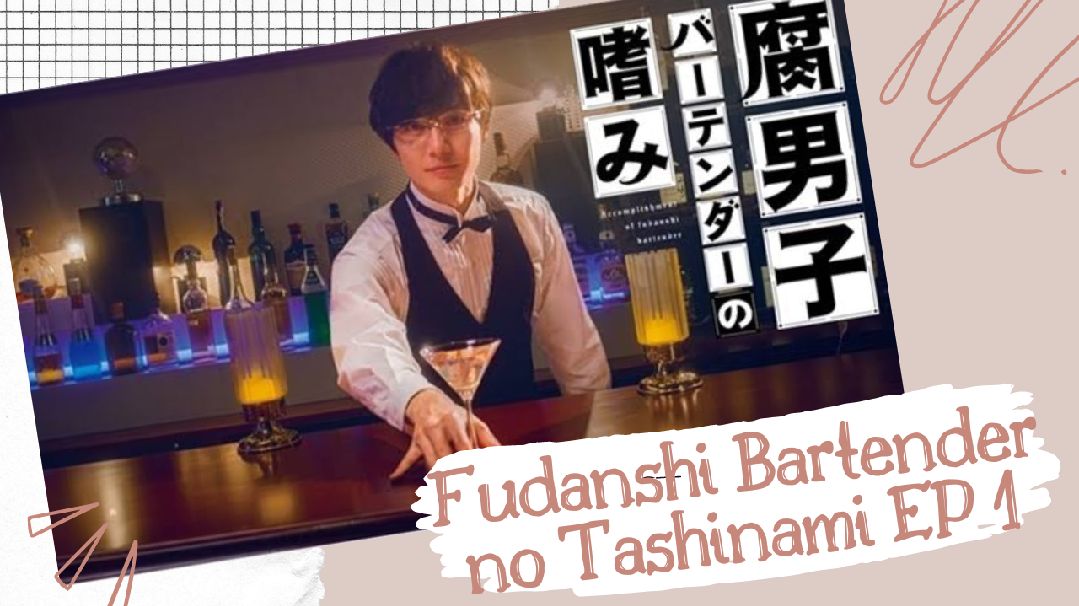
Soichiro Hibiki (Wada Takuma) is a bartender at a bar in Shonan, Japan. On the outside, this young man, handsome and reserved, is a picture of decorum and mystery, taking his job as a bartender with utmost seriousness. Yet underneath that in-control façade is a genuine and obsessed fudanshi to the point he is an otaku. In his free time and days off, he becomes obsessed with composing stories and fantasies about the customers who come into the bar and turning them into couples, ships, and relationships. So much so that he obsesses to himself and ‘sees’ their relationships as a reality thus acting and behaving oddly and strange at times. In his mind, he ‘sees’ them as favorite couples and fantasizes about their relationship. In his mind, he sees these relationships with a Yaoi intensity. Although not negatively directly affecting his work, he does seem to display odd quirks and behaviors that are not appropriate for the situation. In many cases, he is so self-absorbed that his co-workers ask him if something is wrong. But he always seems to have an adept response.
Who really S.T.O.L.E. this series? To watch Wada Takuma as Soichiro Hibiki romp through this role is pure joy. He slips from sanity to insanity back to sanity in a moment with hardly a seam in transition. And it all looks so, well – natural. He goes from a quiet, pensive, reflective bartender to an almost orgasmic fudanshi without missing a beat. His mind is in two different dimensions at the same time. Yet, despite it being a comedy, it all seems a bit sad to me and he seems to project that sadness in his character. How? He knows he is ‘different’ and therefore is unable to authentically feel and can only apperceive when he becomes a fudanshi. I think he realizes that is a deeply disturbing trait and therefore has shut himself off from the rest of the world when he is in ‘character’.
This is a deeply unsettling character study that hides behind humor and retreats to a rather odd world of BL make-believe. How long can that last before his worlds shatter? Honestly, I am not trying to be negative or cast criticism on this series, but I simply did not get the humor and in reality, found the story to be profoundly melancholic.
Another distracting aspect of this series is also a flaw (at least to me) reflective of Japanese BL and that is this constant use of ‘talking to oneself’ to explain actions. Several Japanese BLs use the technique of talking out loud as if they are having conversations with themselves. Occasional use of this is perhaps acceptable, but to continuously use this technique robs us of seeing what actions are being taken by the character. If we could only ‘see’ the character without all the verbiage, what would be our conclusion? It is not a technique that I find works to move the story along. It only makes us artificially conclude the real actions of the individual or honestly not see them at all for what they are. And it is so being overused to explain rather than enhance the story. I do not always want to know what the character is thinking out loud. Sometimes, I want to see it. Or perhaps draw my own conclusions, maybe correctly or also incorrectly.
This is such a short series that it was difficult to reflect on its true purpose. I just did not find it funny. And perhaps I ponder too much for a hidden meaning that may not really be there.
Yet, I am, reflecting upon my own thoughts, glad that I watched this and if you wanted something truly quirky or in a weird mood, then this is for you. Give it a shot!
Leave a Reply