
BLISS RATING: ★★★
“We must never confuse elegance with snobbery.” – Yves Saint-Laurent
Where to begin with this inane self-centered movie. It is classified as a comedy and it does have its moments but overall, this is an intellectual exercise in New York City snobbery. If after watching this self-serving exercise in silliness, one might be left to wonder if this represents ‘gayness’ in the United States. No, and this could not be further from reality. I have met gays from all over the United States and I have never ever met any as pretentious and supercilious as this movie portrays gays to be. Even for the purported mega-capitals of the gay world – San Francisco and West Hollywood.
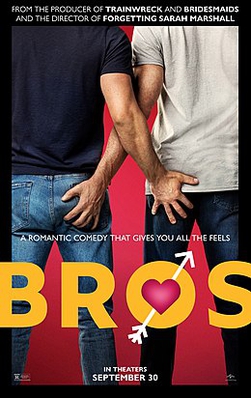
Bobby (Billie Eichner) is a self-described ‘white cis-gay man’ who operates a podcast, in New York City seemingly proud that he is unattached and berates the current gay world with a litany of stereotypical idioms. He is shortly going to become the curator of a new National LGBTQ+ History Museum in Manhattan. While celebrating at a bar, he meets Aaron (Luke Macfarlane), a handsome hot man but instantly analyzed him as ‘boring’. Aaron is a rather straight-acting individual while Bobby is an intense in-your-face kind of person.
Somehow this misfit connection begins to blossom, and they find they are becoming attracted to each other.
Up to this point, the story sort of works but then it got into the realm of nonsense and illogical expression. Aaron confesses that he would love to become a chocolatier. While there is nothing wrong with this ambition, it seemed so incongruous to the situation and tested our sense of believability. And that is the root of the problem with this movie. It goes on in these tangential areas that made no sense and seemed so ‘off the wall’ that they became unbelievable, and you were left with the feeling, “Where is this coming from?
The movie twists its credibility into knots that we are expected to untie and understand. For example, Bobby gets fixated and romanticizes about a part of the museum becoming devoted to the notion that Abraham Lincoln was gay and that should be celebrated. What an absolute nonsensical concept that we are expected to accept as “true” for a reputable museum to embrace just because there are circumstantial information that he might have been. What reasonable, thoughtful, institution of any caliber of integrity and professionalism would entertain such a notion?
Another example of the mind-twisting characters that we are expected to accept as real is when Bobby gets to meet Aaron’s family. Aaron asks him to tone down just a bit his intensity about gayness and its all-consuming impact on Bobby. While Bobby tries, he cannot help himself. He begins to pontificate and expound on all the fallacies of the straight world that are heaped onto the gay world and when some reciprocity is expected, there is a hesitancy in the straight world to do so. Of course, volumes can be written on the efficacy of asking someone who is so consumed and passionate about something, to place some barriers on their level of expression.
But to take offense to that request, seemed unwarranted to me and not an unreasonable request. Yet, Bobby took great offense to it. Is not the point of a relationship to see, accept, and yes sometimes, even compromise on a point for your companion’s sake?
Who really S.T.O.L.E. this movie? The acting in this story is not at issue. It is the screenplay, and the myopic world of what gayness is that seems to only exist in New Your City. No one stood out for me in this movie, and I found all the characterizations too shallow and, in many cases, so stereotypical, which is ironic because I think the point of this movie was to allay this notion. Yet the movie is replete with them.
Fear not, there is a happy ending true to form in the Hollywood sense of the word.
To be sure, I want more than anything on this earth for gayness to be accepted and become so ordinary that an intellectual exercise like this story could be shown. But we are not there. We are not accepted either on an intellectual level or definitely not on an emotional level. So, to show a movie that is intellectually so tangential to the real world and pass it off as ‘every day living’ seemed disingenuous. Perhaps New York City is eons ahead of accepting gayness on both the intellectual and emotional levels, but the rest of the United States is not nor certainly the world in general.
This movie ‘bombed’ at the box office and for good reasons. While the critics were not harsh, the public was. It is noticeably unrelatable, too esoteric, and so idealized that even most of the gay world could not grasp its concepts. Just because something is done ‘well’, does not mean we get its message. The overall message is baffling, sibylline, and arcane. To cover that up by calling it a ‘comedy’ made it feel glib and garrulous.
Leave a Reply