
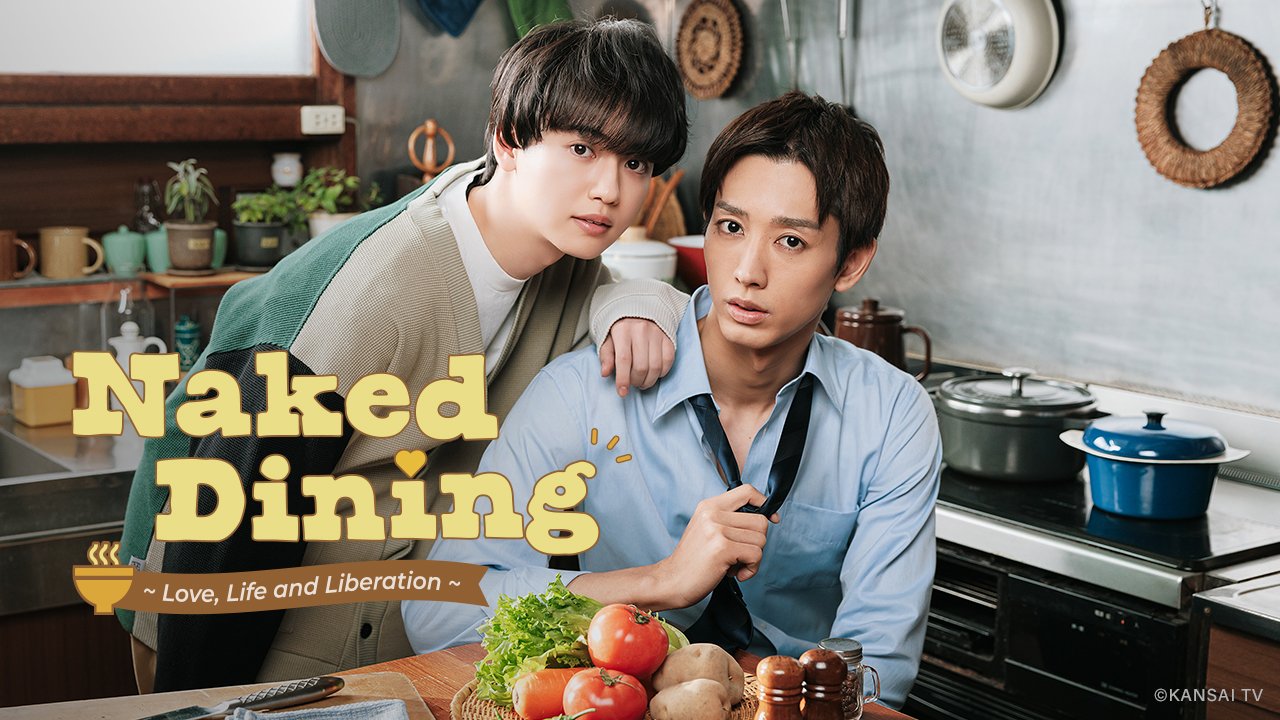
BLISS RATING: ★+
“Your soulmate is surely something that even if you can’t see it, is connected with you somewhere.” – Quote from Naked Dining
This series is pretty much summed up by the quote above with a slight twist. Even if you watched this series, it does not mean that it is actually connected to a coherent story. And in this series, while looking delicious, simply fell apart at the seams trying to prove a point. This is yet again another Japanese series guised as a BL but in reality, it is nothing more than a cute innocuous story at best.
It is another tug-at-your-heart-strings story about a young man named Ichijo Sota (Kondo Shori). An impeccably efficient bureaucrat who is permitting life to pass him by essentially without complaints. A very good and dutiful civil servant. The individual with whom he was closest to is now gone, his grandmother, leaving her place to the family.
Six months after her death via time capsule mail (a concept I truly love) he receives a letter from her to come clean up her place. Feeling like he should go and also perhaps get some closure, he visits the place and finds a book of recipes from around the world she had been working on. Her dream, along with his, was to visit and see and taste the various cuisines from around the world. His grandmother, however, did the next best thing – she created dishes from around the world using the local ingredients and also exotic spices from around the world. By accident, he meets Miki Mahiro (Yutaro). He is the local young man who owns and operates a fresh fruit and vegetable store in the community and had been a continuous companion for Sota’s grandmother. In fact, over the years, they have practiced and perfected many of the recipes in her book and he has also been taken care of the place since her death.
This story could have been interesting, especially by the title alone. Yet, it managed to be simply another trope-filled cliché-injected cute story that had little plot and no romance to it. And the whole notion of ‘naked dining’ ending up simply being a ‘red herring’.
It was a weak affectation of Sota used once or twice in this series but adding nothing to the story or its plot. That is too bad as that whole concept was an interesting notion and could have been a uniquely individual characteristic of Sota that could have been more greatly explored as part of his personality than simply more-or-less a quasi-shock-valued gimmick. Why create it if you were not going to explore it to its fullest extent?
Sota in reality is a rather dense individual and while not meaning to be cruel, really is. Perhaps inadvertently, but that still does not take away its outcome. Again, he cannot think beyond his own actions and their effects on him. His career comes first. His family, particularly his grandmother, became secondary and it was only after he met Mahiro that he realized how much he missed her wisdom, her comfort, and her presence. He is so self-centered that he initially did not even recognize that Mahiro was his former classmate, that he used to provide nutrition for, at the behest of his grandmother, during his high school days. And through her kindness, Mahiro formed a life-long attachment to Sota and to a degree thought of himself as Sota’s soulmate. Yet, for much of the time, Sota rejected his advancements not out of cruelty but out of fear and an inability to accept who he was.
It was because of this continuous cooking arrangement between him and Mahiro did he begin, slowly to realize the value of connecting to people on a more deeply personal and vulnerable level. And to see the depth of Mahiro’s love for him, even if his in return was a bit shaky, unsteady, and most assuredly equivocal.
And in so doing so, decided to ‘use’ someone else to make himself feel more ‘acceptable’ to societal standards. A complex and a bit convoluted relationship between his coworker, Komachi Shimizu (Katayama Yuki) ensues. While she wants a ‘serious’ relationship, a part of her senses that Sota’s heart belongs elsewhere. Finally, when she sees Sota reacting with jealousy to Mahiro’s’ supposed relationship with another friend of his, she instinctually reacts by slapping him (normally something I intensely dislike – but in this case, I am overlooking it). Essentially, for two reasons. One is for him to see that he is jealous and two for him to stop using her as she is not in any way shape or form an object of his affection as he has implied.
Who really S.T.O.L.E. this series? There is such an interesting and pivotal character in this series that is a hub for all the spokes in the wheel to revolve around. He is Liu Hao Shan (FigaroTseng) a Taiwanese individual who now lives in Japan. He helps Mahiro operate the fruit and vegetable market and is quite knowledgeable about all the local and international vegetables that they import. Talented, he helps Mahiro in the co-op in planting and managing to create vegetables to grow locally from different parts of the world so others who live there can use different ingredients. He also offers, without being overtly preachy, wise advice to both Mahiro and Sota on how to navigate their feelings and subsequently their budding relationship before it is lost. He knows from experience what it is like to lose someone by hesitancy and miscommunication. He represented a beacon of hope to try and guide these two to seeing what really is right in front of them that he could see. His wisdom comes from a painful experience of loss which he is willing to share without being pontifical.
The real star of this series is of course the food. And the tenacity of two people and the homage and eulogium to finish Grandma’s world journey of culinary dishes. Perhaps, however, if this series took greater care in developing a deeper relationship between the two protagonists, this might have been an even more interesting story. Instead, it relied on the rather overused cooking-theme to fabricate a story between two people where we were more interested in the dynamics of the two people that the actual making of the food (although the food looked good).
The relationship never got deep and weaved and bobbed like a cork on a body of water. Therefore, it never had a sense of believability, even though they theoretically knew each other from before, because it was never anchored to anything of substance. There was simply no chemistry between the two actors and God knows I never once believed even for a New York minute that they ever had sex together. The feeling and connection were simply not there. Although they were supposed to be roughly the same age, for me, there was a total disconnected. Mahiro just looked too ‘boyish’ to be the same age as the more seasoned and frankly mature Sato. In either case, neither one looked very comfortable in any kind of kissing scene.
Which leads me to why the Japanese even produce BLs if they are so reticent to even hint, imply, suggest, insinuate, infer, or even broach or remotely show even a modicum of connection between two guys in love. Perhaps I am expecting too much even for a slight hint that two MEN might like each other romantically. Outside of a peck, there was nothing else, even when alone, to indicate, even remotely, that these two are anything more than merely friends. Whereas the ‘naked dining’ should and would have been a very interesting and playful notion to have seen throughout, was used merely as an attention-catcher, and a reference point for the end. Honestly, nobody seriously believes that is going to happen. They are just too uptight to do that.
They cannot even show two guys holding hands; you want us to believe these two are going to have dinner together – naked? Oh please!
Leave a Reply