
BLISS RATING: ★★★★+
“Your simplicity is good.” – Quote from One Room Angel
While the above quote is indicative of the screenplay, this story itself is far from simple. Although it has a unique quality of seeming like it does, it is quite complex and very deep, and I loved it because of its deceptiveness. The story is bittersweet and profoundly sad in parts yet focused on making life worth living.
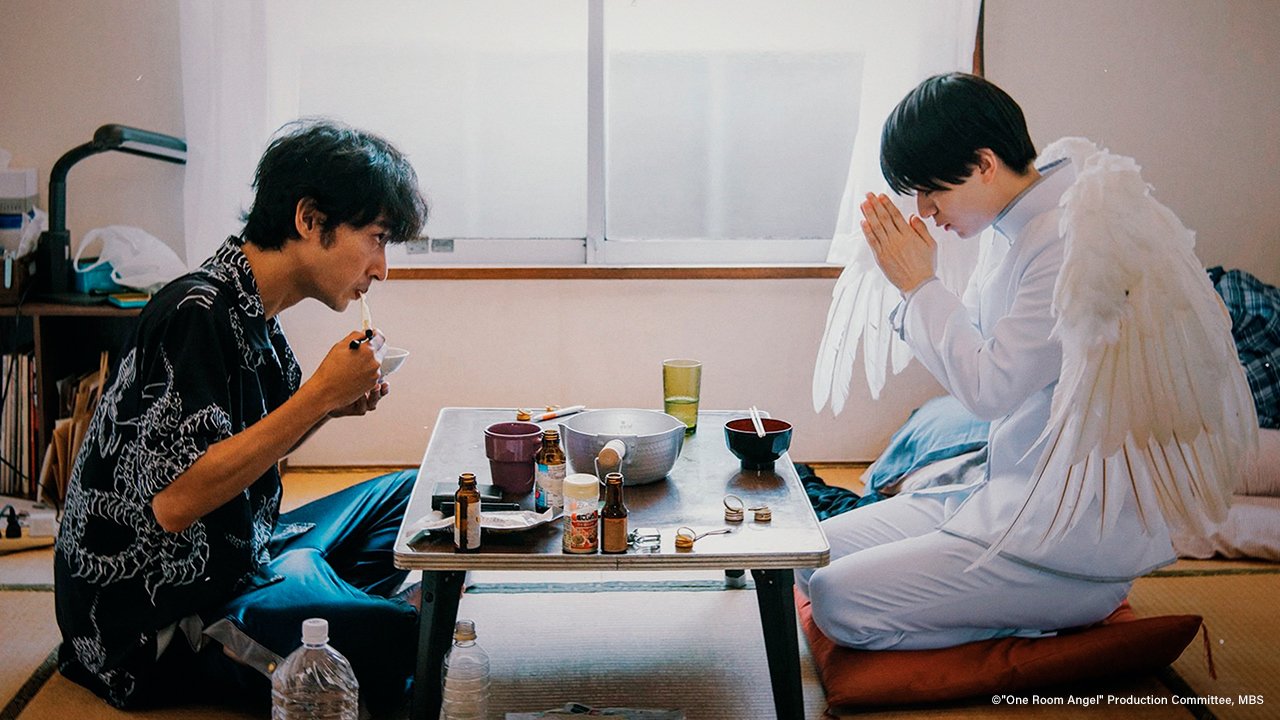
Tomoda Koki (Uesugi Shuhei) by even the best of descriptions is a misfit and on the edge of the margin of living. Almost to the point of giving up on life, he eeks out an existence and ponders his own existence. One night when he is working as a night clerk at a convenience store, he is attacked and stabbed and is convinced he is dying and sees an angel. Yet somehow, he survives and as a curse to his continued existence, he is now stuck with a massive hospital bill. Coming home to his meager surroundings, he finds a young angel sitting in his room with no memory of who he is, or how he got there, or even why he is even here. As unorthodox as this arrangement appears to be for these two mismatches, it somehow feels and seems fitting. And therefore, their slow journey to self-discovery begins and along the way, a transformation begins to take place for both.
Takashina Takashi or Angel (Nishimura Takuya) as Koki calls him, is an angelic looking young man who is as equally lost and fragile as Koki. Both are, for lack of a better term, lost souls, seeking and needing joy in living. Takashi is not your traditional angel; he cannot fly, nor does he have any special powers. In addition, his feathers molt when Koki suffers from negative feelings, which unfortunately is most of the time. Without his feathers at full capacity and not fully remembering why he is there, he is unable to fly. Therefore, he cannot get back to heaven. So, both seek paths to their personal journeys to their heavens.
Along the way, something happens to each of them. Koki begins to mellow, and he inches along a path of seeing life not so darkly but with some light. His connection to the angel has taught him to smile and laugh. Angel, on the other hand, begins to put the pieces of his tragic life together and perhaps why he was sent to stay with Koki. Both have suffered almost incalculable pain and sorrow and as a result carry around on their shoulders tremendous loneliness and isolation. They discovered each other at just the right time and want nothing more now than to be with each other and at each other’s side. They have finally found a sense of contentment, a bit of human happiness, and that wonderful feeling we call joy. And maybe just maybe they experienced a brief taste of love, albeit fleetingly.
Who really S.T.O.L.E. this series? Given the fantasy nature of this series, this could have been devolved into a comic book set of caricatures. Yet, it became relatable with such an odd, quirky set of characters based solely on their fantastic ability of acting to believe in their characters enough to make them ‘real’. These were off-the-wall figures with unpleasant personalities, but they made them more like us than unlike us. We could see their pain, their fears, anxieties, their personalities and what made them tick. Both Nishimura Takuya as the Angel with his ridiculous wings and Uesugi Shuhei as depressed Koki gave these characters a sense of purpose that we wanted to see where they would go and would they remain together. In other words, they made me care for them. Kudos for taking individuals who would have been forgotten by society and turning them back into people wanting to live again. And making us feel that along the way. Even those of us watching sometimes forget the joys of living until we sometimes get reminded by watching others smile by the simple pleasures in life. These two did that so kudos for some fine acting.
This is a very odd story and one that ought not to have worked. There are very unpleasant and shocking realities in this series that are painful to watch. What the beauty of this series has done has turned the ugliness of those realities into redemption and allows for the simple acts of relating to each other in soft, gentle, everyday ways to reignite our love of life that was lost.
At the end, without revealing too much, when the angel finally ‘flies’, the solemnity of the moment is lost in the mundaneness of a simply childish activity without being able to say good-bye. A satisfying moment for one while for the other, it led to questioning whether the angel even existed or perhaps it was merely a figment of his imagination. But when his mother, Arisa (Hasegawa Kyoko), who is herself an odd figure, finds a feather on his floor, Koki bursts into tears and realizes that the angel was real and he was touched by his presence, which gave him new hope, and a new sense of joy in living again and seeing life as worth holding onto to. He was not the only one who cried. I felt it too.
I know this short weird rather unorthodox hesitatingly named a BL which it is not, but that does not mean it has no imagery of love. It is impactful, heartfelt, and mournful but in an oh so quiet, tender, and moving way. It touched me deeply.
Leave a Reply