
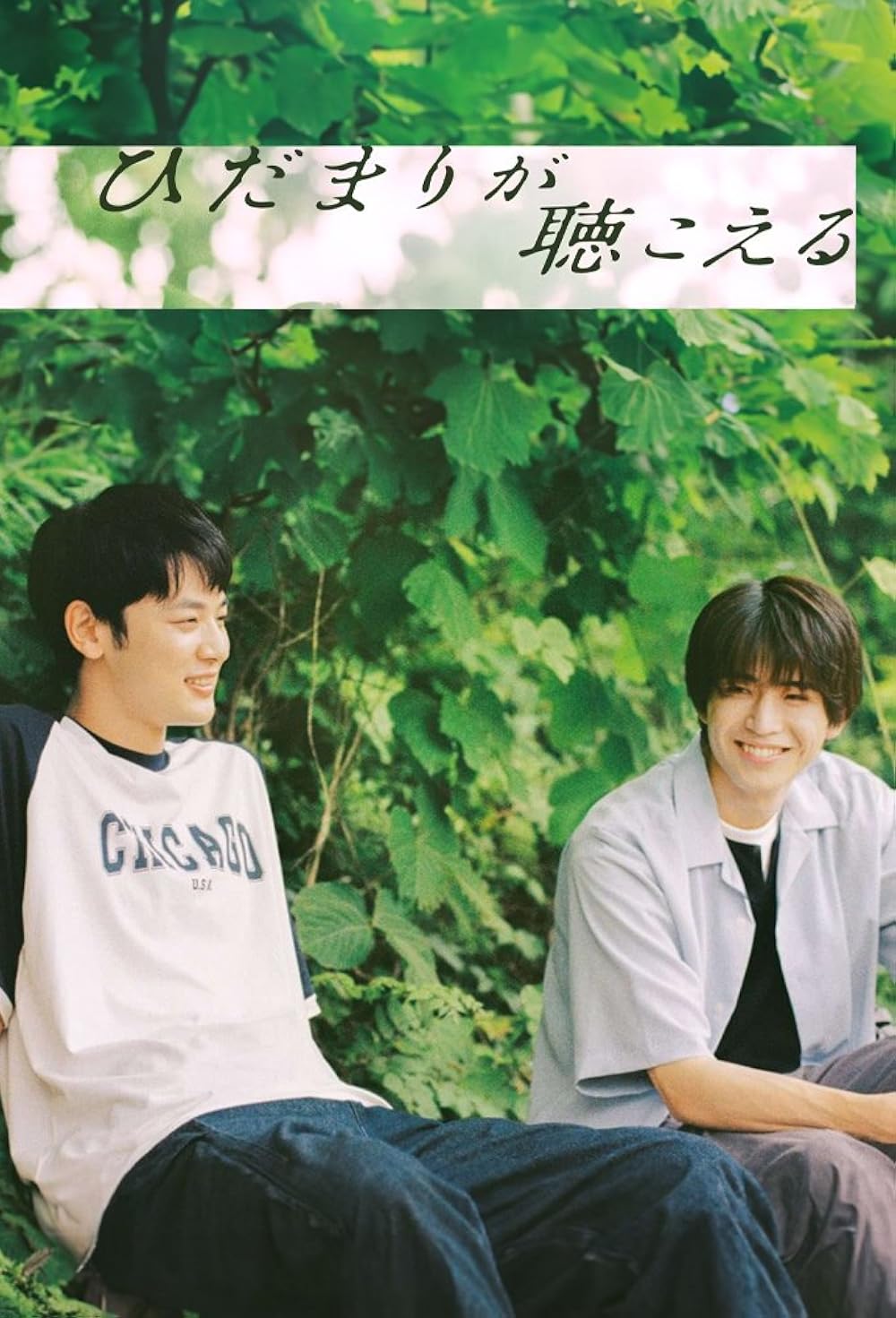
BLISS RATING: ★★★
“He is in a place I can’t go.” – Quote from I Hear The Sunspot
This is a series that got so close to the mountain top but just fell short of reaching its summit. That is too bad as the story itself was original and creative and very likeable. But it all crumbled at its denouement. My own suspect was that they did not want to make it too gay for reasons that elude me.
It is a somber story, really. A handsome hard-of-hearing young college student, Sugihara Kohei (Nakazawa Motoki) by accident and rather clumsily meets Sagawara Taichi (Kobayashi Toranosuke), who is equally handsome. Both these young men are sad figures in their own ways for obviously different reasons; yet both have established a goal to overcome their own personal adversities. Kohei does so by withdrawing and trying to study hard and wanting to be able to fit into the norms of his society by blending in. Because of his extensive hearing loss, not only is that challenging, but it also creates barriers to developing normal relationships and normal exchanges. While he is proficient in ‘reading lips’, that has its limitations.
On the other hand, Taichi hides behind being social and gregarious and essentially lacks discipline in deciding his future goals and focus. Yet, built into him is a strong will to protect and stand up to anyone bullying others. He has been left alone by his parents to be raised by his grandfather. While a loving man in his own right, Taichi feels the sting of not having a family or a family connection and thus the deeper understanding of what love is has been untaught to Taichi. So, for him love is superficial and transient.
Desperate for food and money, he agrees to become the ‘note-taker’ for Kohei. Even though he has not been trained and is undisciplined at times, he becomes somewhat proficient. This begins to help him to understand Kohei. A bond develops. First, it is a bond of friendship but then Kohei begins to have stronger feelings for him. Although Taichi is straight, when Kohei confesses how he really feels about him, he does not run away; he accepts it. He tells Kohei that he could not find a reason to dislike him. In a sense, their relationship intensifies with Kohei trying hard not interfere with Taichi’s presumed natural inclinations. Yet, the harder Taichi tries to deny what he is feeling, the worse he makes the working relationship that they have.
Who really S.T.O.L.E. this series? Who comes into the picture both as a protagonist
and an antagonist is Okami Maya (Shiraishi Yua). She too is also a hard-of-hearing college student and Kohei is her tutor and mentor (Sensei) on campus. Her characterization is fascinating, and she does a superb job of both making herself both a sympathetic character and one who is also despicable. While we can empathize with her disability, that does not give her a hall-pass to be ugly or manipulative or think she is special. She is a bitter, angry individual who wants Kohei to be more like her than like Taichi. She is shrewd and mean-spirited and I think, jealous of their relationship. Until finally Kohei tells her the reason he likes Taichi is because he has helped him accept who he is because he has accepted him for who he is as well. Shiraishi plays this role with great cunningness and becomes a master manipulator inconspicuously. She learned to use her disability to her advantage; the thing she rails against ‘normal’ people doing, she also does. But never sees it, until she is forced to. Her transformation from being bitter to one of learning, slowly, to accept their relationship and desire to live within the confines of societal norms shows real growth on her part. The subtlety in her performance is magical to watch. One minute admiration; the next loathing. Kudos for the ability to create such a range of emotions in the audience or at least in me.
This is a well-acted series and Motoki’s performance of a hard-of-hearing young man was accurate. Having worked with individuals who are deaf, he did a remarkable job. Toranosuke performance as a sociable undisciplined, free spirit was so entertaining. The subtlety of his trying to rectify his feelings for Taichi was quite believable – until the end. Then it all fell apart.
All through this series, although indiscernible, Taichi did feel something for Kohei. Friendship? Pity? Compassion? Bromance? Love? He was constantly worried about him. Concerned about his welfare. In one scene, as Kohei is on the bridge saying good-bye to Taichi, he gives him a sign and smiles. It was the sign for “I love you” which Kohei, normally curious and inquisitive, did not bother to explore its meaning. That disappointed me as I knew that would be a crucial element as to how this series would end.
Finally, Kohei weirdly decided that he liked Kohei but acted like he had no idea that Taichi truly liked him. That was disingenuous and a cheap way of not having to show an intensity in their relationship that this series really needed. Fairly early on, Taichi let Kohei know of his feelings and on the bridge, he signed “I love you”. For him to be confused seemed implausible only because the script said it needed to be so.
The ending felt disjointed, confusing, and very rushed. And for two people to be finally in ‘love’ (after all these are two horny guys getting together for the first time) to muster only a hug is yet again a sign that the series did not believe in its story, or the actors were unwilling to play the part of gay lovers. Utterly disappointing and it robbed this series of a really meaningful connection between two lovers.
This series had so much potential. The relationship between the disabled and ‘normal’ worlds was captured with good accuracy. You had a protagonist that found his calling from this experience in wanting to devote his professional life to helping others. We see that individuals with a disability can and often do use their disability for the wrong reasons or use it as an excuse for inappropriate behavior. This series would have been an outstanding one if it had taken it to a greater intense level in which we were shown that an actual and genuine real love relationship could occur. Not a perceived pablum one at the end within the last 5 minutes of a series.
Or another realty could have been that they remained ‘friends’ with Taichi simply unable or unwilling to make a commitment to Kohei. That again would have been honest. Real. Something. Anything other than a contrived lame ending.
This is a good series; not a great one. It could have been an outstanding one, however.
Leave a Reply