
BLISS RATING: ★★★★★
“Love has no age, no limit; and no death.” – John Galsworthy
While I have no way of scientifically testing my theory out, I am guessing that this series will be way more poignant for individuals OVER 40 than under. Moreover, its cogency will also be greater for those of us who are way, way over 40, even if it takes 12 episodes to get there. This is one time when the belaboring to get to its efficacy is worth the wait. For the journey to get to the moment of love is the ethos and thus worth watching: it is reflective, pensive, wistful, bittersweet, yet so astonishing fulfilling. Indeed, this is one of the best BLs to come out of Japan in a long time.
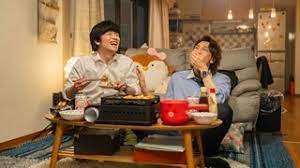
Perhaps those of you in the prime of your life (well under 40) will not relate to or understand the agony and personal purgatory of Tojo Suzume (Kazama Shunsuka). Here is a man who is hard-working, humble, respected, but deep-down lonely and very much alone. Pretending that it does not affect him, he knows that as he is approaching his 40th birthday, he is isolated. His only companionship is his stuffed plushies that he talks to in his apartment while usually cocooned in an animal pajama costume, enveloping himself for a sense of comfort. Suzume himself is not honestly a bad-looking man; yet he projects the outward impression that life has passed him by and therefore ‘old’ and subsequently unattractive. He has become a sad figure of his own making.
One evening while he was working alone in the office, he ruminated on so many larks he wished he had completed. Therefore, impulsively, he decided to develop a list of ten adventures he would like to experience before he turns 40. Ten bucket-list activities, if you will, out of his comfort zone. He has 3 months to accomplish them. Unbeknownst to him, his younger subordinate, Tanaka Keishi (Shoji Kohei), was also working late and stumbled across his list. In a rather brazen admission Keishi admitted that he wants to help Suzume fulfill his list, as he is gay and likes him and wants to help him in his journey of self-discovery. Keishi is a tall, very handsome, obviously younger looking man than Suzume. Yet, his feeling for Suzume seems sincere and real. And his intentions seem quite genuine.
As the weekends roll by, and they get to spend more time with each other, Suzume finds out so much about himself and begins to enjoy life as it was meant to be. Yet, three hinderances are always in the back of his mind. One is the vast age difference between them; two, he is Keishi’s boss. But there is no doubt the two of them thoroughly enjoy each other’s company and companionship. Yet, both are reluctant to take it to a deeper level. The hesitancy is beginning to create more uncertainty, not only for Keishi but now creating even more mistrust in Suzume. Mistrust that it could ever work out between them. How could anyone younger than he be interested in him? Finally, the third. His own self-doubts, fears, anxieties and his set pattern to always handle everything on his own. He has no idea how to handle his raging mid-life crisis.
Everything is going along swimmingly until Tanaka Hayata (Hirai Amon), a coworker of theirs, accidentally discovers them on one of their weekend outings and point blank asks them if they are ‘dating’ each other. While he is ‘open’ to that, his hidden intent was to imply the oddity of such a connection. Panicking and trying to diffuse, both deny it vigorously. Obviously in a moment of not thinking clearly, Keishi says that even if he was gay, he ‘certainly would not be interested in someone like Suzume’. Crushed and destroyed by that statement, Suzume reverts back to familiar ideation – the ugliness of his own insecurities and self-doubts. The shell around him that has protected him for all these years. That shell, however, has kept him also isolated and alone. Therefore, his old ways of trying to handle everything, including trying to meet all his emotional needs on his own, grabs him like a vice. At that point, he realizes how deeply in love with Keishi he really is, but his intellectually side tells his emotional side that it simply will not work out. Figuring the only right course of action, he tells Keishi that they must stop seeing each other.
While Suzume seems like himself on the outside, his inside is being torn apart as his birthday approaches. He now realizes that he must spend it all alone – again without anyone. Yet, the dream of loving Keishi is crushing him.
Who really S.T.O.L.E. this series? This series is interestingly constructed to allow for the minor characters to have more pivotal engagements than what the roles would seem to have. As irritating as Hayata was to their break-up, he becomes, with almost poetic justice, the driving force for Keishi to see the big picture for what is happening in his own relationship with Suzume. He understands how his lack of empathy and self-absorption contributed to their schism and how he regrets his poor choice of words without thinking through what he was saying. Suzume’s boss is a unique character as he recognizes that something is troubling Suzume. In his own awkward way, he was trying to convey that there was always someone here who would be empathetic. I felt he knew more what was going on than he would allow himself to say. When Suzume visited his family for a barbeque, his daughter recognized that something was weighing heavily on Suzume as he seemed sad. When confronted with these realities, Suzume dismisses their concern, but they indeed are the catalyst for his later actions. He realizes that indeed he is weighted down with loneliness and isolation and an inability to say what he means when it comes to wanting to love Keishi. The subtilty of all these performances should not be taken for granted. There is a real skill to what they were attempting to convey in these characters and each one of them shined brightly. Just remarkable performances that helped put a cohesiveness to this series.
If you allow yourself to be taken in by the flow of this story, you may then be deeply affected by it. As I said, those over 40 may relate better to its inference and how abscessed it was for Suzume. No one, unless you personally experience the profound loneliness and isolation of being by yourself, can understand the panic there is to allow someone else into your world. Let alone someone much younger who could be in it only for the thrill or the whim of chasing after an older man or any number of other reasons plus the fact that he is your subordinate. When Suzume deleted his wish list, without fulfilling it before his 40th birthday, I cried. It impacted me as I knew what he was feeling because he had resigned from life and decided to face his time alone. Much like him, I had been there and felt that indeed life was over. I too could do it all on my own.
This does end up being a redemptive story. Suzume comes to a realization that he must act. Otherwise, it is over. No matter how hard he tried to push Keishi away from his mind, he would not go away. Either psychologically or emotionally. He knew his love was genuine and he knew that deep-down so was Keishi’s love for him.
So, if you want to euphemistically see a very lonely boy-child suddenly burst into becoming an adult male, this is a story for you. It is a drama of courage, strength, and emancipation. Perhaps only involving one with the end result being two people being happy. There are not many stories where an awkward couple was able to make it work and make it feel right. Nothing felt off about this series. There is nothing that Suzume and Keishi cannot handle.
Finally, it is a bit unfair to compare this series to others and therefore do not. It is not “Cherry Magic” or “Old Fashion Cupcake”. Suzume knows very well that he is in love with Keishi almost from the beginning. Mid-life crisis is a funny creature. It is both ugly and exhilarating. It is a time when you shed old ways of thinking at the same time you realize that you become less desirable. At least you convince yourself of that. Is it oxymoronic? Sure! But Suzume was going through a difficult phase and in a split second of universal clarity, he runs off to tell Keishi of his desires to be with him, despite having been told by the person he loves that he would not be his first choice, even in jest and to ‘save face’, stung and was deeply wounding. You must be his age or older to fully understand this revelation of perspective, honestly. On the other hand, Keishi understood Suzume completely and realized that despite all his foibles and fears, he was the one person he wanted to spend the rest of his life with. He would still stand by Suzume.
This is an astonishing and touching love story that is more deeply discerned by those of us over 40. Yet will be understood – someday – by those under 40. Give it time. You may eventually see yourself as Suzume.
This one is going on my Apotheosis List. It is an unfailing BL for sincerity, genuineness, and character.
Leave a Reply