
BLISS RATING: ★★★★
“Let’s make clothes that give people the courage to get close to each other.” – Quote from Punks Triangle
This series is a deeply pensive and reflective mind-twisting journey into OBSESSION. And not just of one individual either. It focuses on one young man’s adventure into a world of devotion, adoration, fixation, and absorption to another human being. This individual became his goal, his preoccupation, his desire, his passion in and for life. Meanwhile, the other young man starts out as being curious about the other but then slips into the abyss of falling in love without knowing why and falls prey to his own set of undefined impulses.
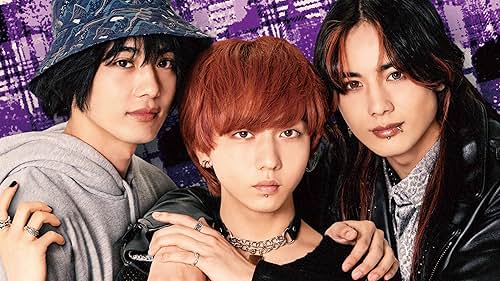
Sumiura Chiaki (Nagano Ryota) is an isolated, lonely high schooler who one day attends a fashion show and is captivated and enthralled by a celebrated punk-clothing model named AE (Fujibayashi Yasunari). Chiaki alters his look, gets a lip piercing, and pursues fashion design – all aiming for AE to showcase his work one day. Engaging in evening classes while working, he shelters himself by remaining aloof and becoming a loner but always taking his studies seriously. One day, the instructor announces that the next project is to design an outfit which a famous celebrity will wear and that celebrity is none other than AE. However, this assignment must be done in pairs. With no other options remaining, he is partnered with Enaga Ayumu, a character who presents a quirky almost dorky appearance but does demonstrate a distinct affinity for fashion design.
Unbeknownst to Chiaki (and honestly to me for some time as well), Enaga was none other than AE himself. The narrative follows a captivating love triangle involving AE, Enaga, and Chiaki, with Chiaki unaware that Enaga is actually AE, until the competition nears its conclusion.
Who really S.T.O.L.E. this series? This is an easy choice. Hands down, it is Fujibayashi Yasunari as AE/ Enaga Ayumu. He ‘fooled’ me for some time as to his true identity. That is because of his extraordinary acting. He literally became two different individuals. Fujibayashi Yasunari melded these two characters so astonishingly seamlessly that they are two different individuals. And he disguised and guised his identities with ease and conviction. I can honestly and forthrightly understand how Chiaki did not ‘see’ Enaga as AE. He hid and concealed that persona so well behind the façade of Enaga. Too well, as a matter of fact, which caused him then to have moral quandaries as to how to divulge his true identity to Chiaki. We see so many facets of both characters with clarity by Fujibayashi Yasunari that he did seem like two distinct individuals. An astonishing and commendable representation for a rather complex acting challenge that he honestly made look simple. He showed us so many different dimensions to both personalities that we honestly got to know both well.
Where the story fell from grace for me a bit was in the character of Chiaki. He was a remarkably complex individual that the director made too simplistic. He infantilized him by making him stagnant. Chiaki was and is such a deeply troubled young man that at times, I thought could even be so clinically depressed that he might be suicidal. Why did I think that way? Well because he isolated himself so much and looked at the world and everyone around him more as an annoyance. He simply saw no value in others and saw little in wanting to interact with them – save only one. AE. AE was not just his savior; he was his goal in life. He worshipped him. Knew every aspect of him, including the way he walked the runway. Wanted to be near him. Was it love? Yes and no. He loved him much like you would love a god-like figure. But no, not as someone who ‘turned him on’ or someone he wanted to spend the rest of his life with intimately. That, surprisingly, became Enaga. Chiaka separated the two of them and had a separate love for each.
When Chiaka realized that they were one and the same, there should have been an explosion of emotions. Instead, it is more like a whimper, a whisper. Honestly, this is a complex human drama full of pain on the parts of both Enaga and Chiaka that should have been more emotionally charged than what it was. It got close in a few scenes but never got as deep as the premise led us to believe it would.
For me, three factors lessened the impact of this otherwise excellent account of personal struggles:
- Chiaka never grows. He never goes beyond seeing the world through the lens of his own perspective. Everything is and must be on his terms. His same expression with AE wore thin after a while and his naive reactions, nervous looks, quivering lips, running away, etc. to difficult social interactions were just too frequent and overused. He never seemed to advance. Sure, we all understand the pain he endured from individuals he loved keeping secrets from him, but he is now an adult and must learn to put life in its own context and perspective. He has to learn to live in a society.
- The first kiss between Chiaka and Enaga as AE, which is literally the watershed of this whole series, was a complete and utter disappointment. Sure, it might have been understandable, but it was so anticlimactic and frankly a cop-out. It defeated what was otherwise going to be one of the best Japanese BLs of the year. They could not give us a kiss that needed to be passionate, intense, hot, and incandescent. This WAS the point to this story and they missed – completely. Honestly, this story candidly screamed for an impassioned love relationship between two rather sad and lonely individuals who happened to find each other in a most unlike setting. We really did not get a love story; only a lead-up to one. I expected and wanted and, in this particular case, demanded more since this whole story was about intimacy. This is yet again another disappointing Japanese BL unwilling to take a love story to a level where we can believe there is a gay relationship about ready to blossom.
- The production itself has flaws in it that cannot be overlooked. The use or more accurately, overuse of flashbacks is maddening. Every time this technique IS used, it signifies a weakness in storytelling and plot development as it becomes ‘filler’. While I appreciated the fashion design/creation aspect of the plot, way too much time was spent on these details that I did not need to know about. If that was meant to speed along the relationship between Chiaka and Enaga, it did not. Just because they dressed and acted like ‘punk’, did not make them punk. Looking the part does not make it so. Sometimes it all seemed so superficial and that they were literally playing their parts. Admittedly, I know NOTHING about punk, but I want to believe I do. Thus, the point of the story is it needs to convince me that they are punk. If the story had been more intense, perhaps the sincerity would have shown brighter.
I honestly cannot say I disliked this series. On the contrary, I thought it was well done for about three-fourths of the way. It fell apart at the end right after Chiaka twisted his ankle for the runway walk. I knew then, the story was going to hurriedly end without a more reflective and challenging transition for both protagonists. It got so close. Then it fell flat. Seeing two men in a sexual gay sexual relationship in Japan has a long way to go before it reaches an affirmation. It still needs to grind through in an esoteric stage of acceptance.
Leave a Reply