
BLISS RATING: ★★★+
“You only carried him in your womb for 9 months. I have been taking care of him every single day for 10 years. I won’t give birth because I am not a woman. But I am a mother. I am his parent.” – Quote from Call Me Mother
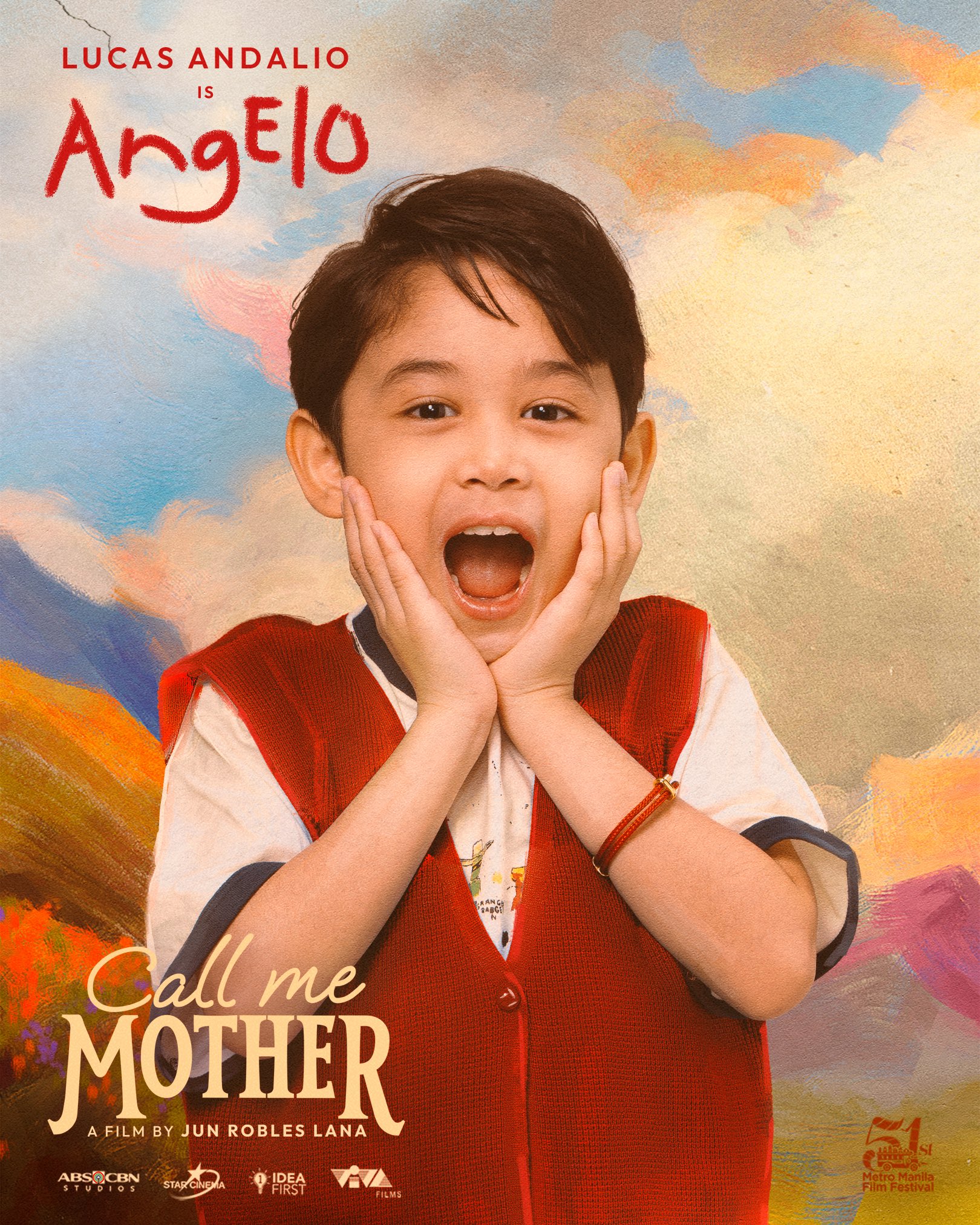
Who really S.T.O.L.E. this movie? It is unusual for me to begin a review with this domain first, but this character is not only central to the story; the actor playing him shines like a lantern throughout the film. Not merely forasmuch as his naturalness to acting, but also to the thoroughness of his commitment to the role. He will quite literally steal your heart with the range of emotions he displays as a young child responding to a world that he is given, not chosen. I am talking about the role of Angelo played so organically by 8-year-old Lucas Andelio. He is this movie. Lucas represents and displays, in addition to the innocence of youth, all the unconditional acceptance of the only person whom he has known as his mother. He perceives and accepts Twinkle (Vice Ganda) as his parent. He knows that because she is there for him and always will be. He discerns and senses that down to his core. His ‘real’ mother is separate and as yet unknown to him. And Lucas captures all of this with his acting. There are touching performances and then there are seismic ones. Lucas exhibits such intensity to his interpretations of the role of a 10-year-old boy that I became mesmerized by his emotional commitments. One scene of particular note (in a car), I was so overcome with sadness by his show of profound anguish of separating from Twinkle that I openly wept. He had touched me that deeply. Angelo is so pivotal to the story and Lucas made it extra special with his complete commitment to the role. It is no wonder that he won the Best Child Performer at the 51st Metro Manila Film Festival. Along with his boyish charm and natural handsomeness, Lucas has a bright future in acting and has already established himself as a caliber craftsman. Kudos for an exceptional performance.
The premise of this movie is essentially a simple one but is made complex by its presentation. Granted the movie is primarily for a Filipino audience. However, if you are going to appeal to a wider audience (since it is now shown on Netflix), you need to display (produce) it in such a way that is clearer to a wider audience. My husband who is Filipino had to explain to me a lot of the nuances of its presentation that then made it much more relatable and understandable.
It begins with Twinkle who is a queer cross-dressing beauty pageant instructor and is an authoritative maestro in what she does. She is at the top of her profession now. One of the current protégées she is training, Mara (Nadine Lustre), however, finds herself pregnant and hides the pregnancy and birth from the public. Giving birth, she then relinquishes her legal rights to the baby. However, the person who was responsible for the baby suddenly dies and Twinkle, who was close to that individual, takes over raising of Angelo.
The upbringing of Angelo is a tale peppered with humor and angst. Twinkle is an uncommonly fascinating and dynamic individual who devotes, adapts, and undertakes her life and existence to provide Angelo with the best possible quality of life. With little outside support, Twinkle scrapes along on her own. How she gets to live where she does is a bit cryptically presented but perhaps understood by the Filipino community better than those of us looking on the outside in. I was confused by it all until my husband explained that this living arrangement is typical for those trying to ‘make it’ in Manila. The one consistency throughout this saga is the deep, deep love Twinkle has for Angelo and her passionate commitment to and devotion of being the best mother she is capable of being.
The issue arose, that since Twinkle never legally adopted Angelo, she could not take him on her potential new employment prospect in Hong Kong. She needs to legally adopt him and in order to do so, she must have Mara sign over her legal rights to him for her to adopt him. When Twinkle asks Mara to do so, she will agree to do it only if Twinkle now helps her win the next national beauty pageant that eluded her 10 years ago. Twinkle agrees only if Mara abides by the condition to stay away from Angelo.
Of course, that becomes impossible and before long, Mara begins to interact with Angelo and at a dramatic moment during the question-and-answer portion in the beauty contest, Mara confesses publicly her life story about having a child and the consequences of the pain of giving up her child. With that, Mara retracts her permission to give up Angelo and a heart wrenching but powerful exchange between Mara and Twinkle about what is motherhood ensues.
The story is a formidable one about the concept of motherhood. Who and what is a mother? The proverbial paradox of nature vs nurture dichotomy. What role does biology play against what role does actual parenting play. Which contribution is a priority? The dialogue between the two is poignant, intense, and touching. Caught, of course, in the middle is a little boy who knows not of the difference. He knows who ‘mama’ is as opposed to his ‘real’ mother. You cannot ask a vulnerable and scared little boy to choose. That is what adults do when they play mind games with children. Angelo teaches both a lot about what it is like to love and how encompassing love should be.
This is indeed a significant story that for me never reached its zenith. It concentrated a lot with trying to provide humor; understandable as so much of this story is wrapped in tongue-in-cheek dilemmas that plays into Vice Ganda’s forte. One technique, however, that I detest that is used just a bit too much is ‘fantasy humor’ in which one individual imagines a response to the other party that is over-the-top twisted but would never happen. Although these moments may have been intended to come across as humorous, they felt misplaced and awkward in this kind of film. More serious scenes would have adeptly been consequential. Instead of adding clarity or becoming meaningful, relatable reactions – even uncomfortable or negative ones – the theatrics diluted the emotional puissance of the scenes.
There are a lot of characters in this movie which I am guessing the aim was to expose potential newer talent to the acting world. While there is nothing necessarily wrong with that, it seemed superficial and did not add much to the flow of the story, except for occasional side-tracking bemusements. I am not sure what the point was to having so many characters.
Although I have nothing negative to say about the acting abilities of Nadine Lustre as Mara and Vice Ganda as Twinkle, I generally was unmoved by their performances. The exceptionality to Vice Ganda’s performance was that she did not turn it into a caricature. To be sure, each had some powerful scenes both individually and together. Nevertheless, overall, the story did not showcase either actress strong enough to make their characters feel emotionally invested. For me, both seemed constrained by a weak screenplay that muted what should have been fiercer, more expansive emotional moments, replacing genuine sentiment with predictable clichés or comic reactions. For instance, Mara gives up Angelo so abruptly that we never fully see the anguish behind her decision, which could have clarified why her lingering pain should have felt so profound. In addition, Mara now has a boyfriend who, hearing all of this at the pageant finals for the first time like everyone else, seems to accept it all without any conflict, anxiety, or shock. I find that startling and unrealistic. There is not one scene with how he felt and yet we see him accepting Angelo without reservation. Is he not an important element in her relationship? On the other hand, Twinkle raising Angelo is shown more for humor or purely contrived heartstrings but not from the pain she personally would have faced as both a ‘mother’ and a gay person. I think we needed more so we could feel her inquietude. Many intense moments throughout the film needed a deeper emotional connection to help the audience feel more invested in the characters.
My dilemma with this movie and story is that it is primarily labeled as a comedy. I do not find the subject matter funny and the main premise, one most serious. This story is about the sacrifices mothers make for their children and whether you think Twinkle is a mother or not; unquestionably, she indeed was. One discourse with Mara proves that beyond a shadow of a doubt and when you hear what she did for the welfare of Angelo, the question one needs to ask is: “Would I have done the same thing?” And then further ask yourself: “How could one doubt that she is his mother?” As Twinkle reminds Mara, motherhood is not just about giving birth but about showing up every day – loving, protecting, and choosing the child no matter what. Unfortunately, I am not sure if that question is truly answered unequivocally in this movie and/or certainly not in any satisfactory fashion.
So much could have been explored with this story. Mara, in a sense, played the greater victim here than Angelo. Announcing to the world that she is a ‘mother’ when in essence, she was and is not. Almost then making Twinkle feel her job is done, with the hard part now being concluded, and, in a sense, making her the sacrificial lamb. I thought Mara’s actions were astonishingly selfish with little thought to the actual needs of Angelo or the inevitable psychological destruction of Twinkle. It is what righted her ship from sinking while Twinkle’s ship sank. That really needed to be explored more extensively and thus the whole story felt so rushed and incomplete.
While some of the scenes was certainly dynamic, especially towards the end, the rest of it tended to be gimmicky and played to who the actresses were but did not challenge either. I simply wanted more from both. The screenplay was a bit of a disappointment for me and with so many superfluous actors and actresses trying to get a piece of the story, it got a bit helter-skelter. Nevertheless, the story and movie are solid, and it is one that many may find even poignant.
It is also important to watch this film for the astonishing performance by an 8-year-old boy named Lucas Andelio. He truly is the cynosure of the drama and the movie.
Leave a Reply