
BLISS RATING: ★★★★★
“Everyone lives for their own piece of mind.” – Quote from Boy, With Caution
Series from South Korea this year have been either disappointing or almost getting there. Until now. This is an exceptional and rare story and, for me, an objet d’art. With a caveat emptor, however. This is NOT a story or series for the BL traditionalist, as it has no romance warble to it. In fact, it is the antithesis of that. It has realism and veracity. This narration stands alone and is an epic.
From the very beginning, the story envelops you in an aura of darkness and keeps you there throughout. It is a story of and about depression and its depth on one specific man, who tries on occasion to rise above it by attempting to display empathy towards others. Unfortunately, every time he does so, it creates the wrong impression on the person with whom it was intended to help. And worse than all of that, he is powerless to stop himself or see how his compassion may have caused the pain. He is too far down into the depths of his own despondency.
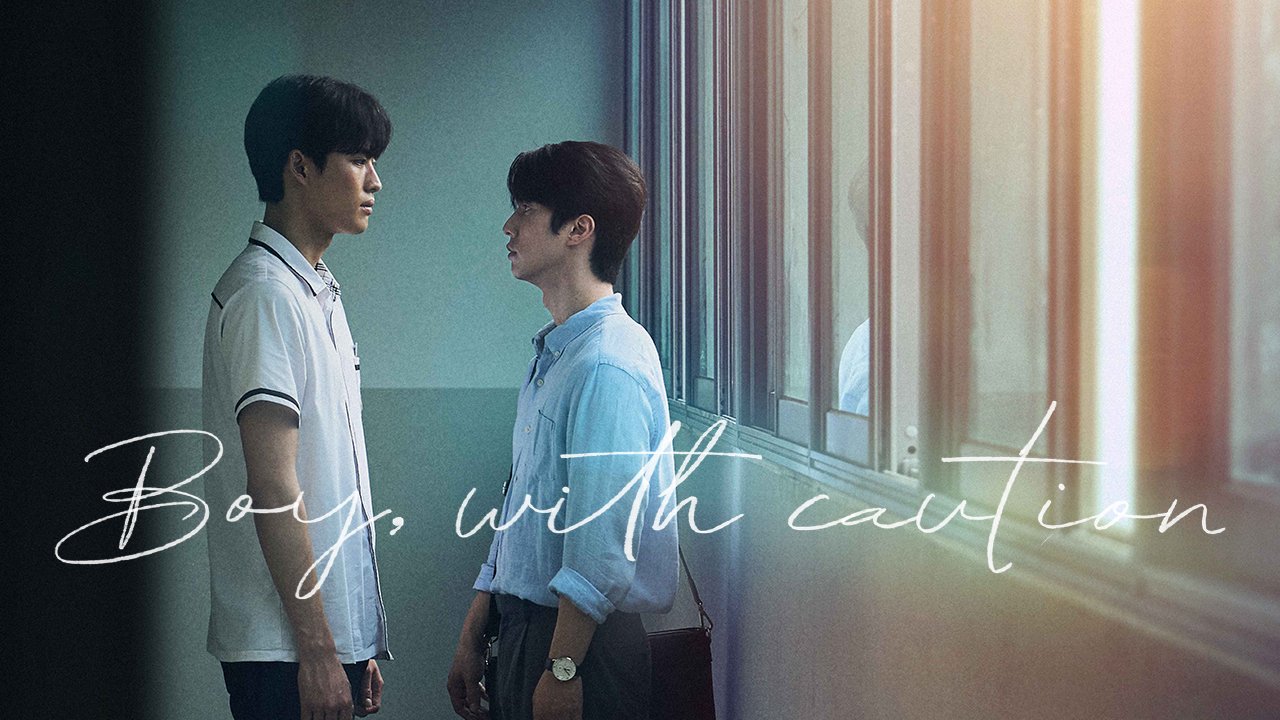
A 32-year-old male teacher named Jang Gi-woo (Ryu Seil) only holding a temporary teaching certificate is paralyzed. Not physically but emotionally. He lives inside a human shell but is pusillanimous to express himself for who he is. Unhappily married and pressured to continue to be so by his mother; even his wife is trying to get him to become less fearful and timid. She long ago left him. Yet each day he simply recoils more. He has been a product of an unsubstantiated and unproven ugly rumor of him and a female student which was fabricated. Of course, he does nothing to either clear his name or move on from it. Meanwhile, in the background his mother goads him to become more successful and to get back to living with his wife. Obviously, his wife, in the interim, has moved on and is waiting for him to show some backbone and character to evolve.
When offered another temporary teaching job, he takes it. Sure enough, this time he gets himself involved with an older male student with a troubled and questionable past. Lee Hyeon-jae (Ha Jung-hoon) is a tall, lanky postpubescent student who is strangely entrancing. He coasts and skirts along because he is the ‘Chairman’s son’. There is a strong sense of virility about him. Perhaps unconsciously, that is the reason Jang Gi-woo is drawn to him. His own true sexuality is deeply hidden in the closet. Lee Hyeon-jee comes into class all bruised up with the obvious conclusion that he has been in trouble for selling drugs to others and has been beaten up for it. Yet Jang Gi-woo does not quite believe that and because of his attraction to him tells Lee Hyeon-jae that if he wants or needs to talk, he will listen. This source of comfort for Lee Hyeon-jae becomes the mechanism for transference and he, for the first time, begins to feel a sort of love. He begins to fall in love with Jang Gi-woo. In every sense, Jang Gi-woo is incapable of love. However, that does not mean he cannot; it means he will not. Jang Gi-woo keeps drawing Lee Hyeon-jae closer, seemingly driven by an unseen force he neither understands nor controls.
Who really S.T.O.L.E. this series? There are several other students in the classroom that Jang Gi-woo has taken over that have been certainly problematic. Two, however, have a touchy by intense relationship. Jungha played by Lee Jung Chan has an interesting nickname in school – Vending Machine – because he will do literally anything for money. He needs the money for his grandmother’s care. His activities have caused him to become involved in the fringe elements of the school in order to make money. His friend, Sungwon played by Jung Si Wan avoids trouble but follows Jungha around trying to convince him to give up doing the shadier aspects of the underbelly of selling drugs to make money. Although it is not clear what kind of a relationship they have, it is obvious it had been an intense one as they are to some degree inseparable. And each time they meet, there is palpable sexual tension between them. It is obvious that they are in love with one another but neither know how to convey that clearly or even gently. Their relationship does not firmly develop until the end of the series, which is a shame as the two actors portray their characters with such intensity, not so much with words but with facial expressions and outward emotions. The looks of pain on both their faces when they know they both sense they are in love with each other, and want one another, but their circumstances do not allow them to be together. All the same at the end, there is a glimmer of hope that they will try and make this work. These two actors did such great jobs in creating a forceful and effective emotional and sexual tension between themselves that we know that each time they managed to be together, that somehow, they were being drawn closer together.
This narration is ugly, doleful, and melancholic. It is equally filled with a sense of darkness and heavyheartedness. Depression is everywhere. The main protagonists are both depressed and despondent and have given up on living. The students in the class are only going through the motions of learning and looking for and seeking thrills and/or escapes from their drab existence. The remaining teachers have long ago given up ‘teaching’ and have merely become functionaries, passing them along to the next level or letting ‘the system’ handle them, however they will be defined. The ‘Chairman’ is the quintessential despot who rules the school system and everyone in it and has complete and unyielding immunity. Jang Gi-woo’s marriage is a sham; long ago withdrew from it. Lacking the tenacity or conviction to deal with the failed marriage or his dominating mother, he veritably has given up and meanders around only a shell of a human and functions emotionlessly. Although overt, one of the reasons for Jang Gi-woo’s failure for the intimacy with his wife was because he was fostering attraction to males that became elevated by Lee Hyeon-jae’s attention. Nebulous, undefined feelings for males that is unclear and unspecified but there, nonetheless.
However, on occasion, he discerns a spark of humanity. Why he does so is perhaps his way of seeking help for himself. His reasoning is irrelevant for it will inevitably lead to an involvement that will create more issues than it solves. While his initial concerns for Lee Hyeon-jae might have been real, as he was astute enough to know and figure out that the bruises and marks on him were not caused by other students. He felt a connection because he knew his father was beating him. Maybe having been controlled by his own mother for many years led him to feeling empathy. For Lee Hyeon-jae that spark of interest soon turned into something deeper. Having found Jang Gi-woo’s wedding band, he began to live in a fantasy world of his own creation. He transferred Jang Gi-woo’s compassion into a form of love. Twisted, perhaps perverted, but nonetheless real to him. And, despite his protestations, Jang Gi-woo allowed him too. How? By becoming even more involved with him and before long, an intimacy was created.
Before everyone clutch’s their pearls about how wrong it was for them to have had a sexual encounter, it was. However, a distinction must be made here. Both were adults. Did Jang Gi-woo violate the ethical/moral code of conduct by having a sexual relationship with a student? Yes, he did. Does he warrant becoming a teacher? No. While I will not pretend to defend his actions, I understand them. There are no morality and ethical standards to this story. The protagonists are NOT even at that level of understanding those basics. I am not excusing their behavior; merely trying to explain it. What the sex for them was all just about the feeling for each and both. For a moment, they are human, lost in their own world of delusion, and it was befitting for them to have this sense of involvement. Their intimacy was neither pleasurable nor satisfying but was needed to make them feel whole again. It was an instinctual act and an opportunity to reconnect with humanity again. The rest of us might think of it as a moral failure or ethically offensive; they would think of it as a necessity for the growth of both.
This is a harsh and cruel story. While it might appear that there are no winners here, only losers, I would argue just the opposite. Although Jang Gi-woo appears to be cold and calculating in his treatment of Lee Hyeon-jae, he did so because he had no other options. He had to categorically reject him in the end. What he had done was wrong and he knew it.
My belief is that he may even have fallen for Lee Hyeon-jae and was beginning to realize the futility of even trying to develop a relationship with the ‘chairman’s son’. Jang Gi-woo himself was depressed and he recognized it. He made the decision to get a divorce from his wife. He further determined that he hated teaching and wanted to be a counselor. Plus, he needed to and finally embraced head on dealing directly with his mother. All these decisions were possible and probable because of his encounter with Lee Hyeon-jae. He also concluded that Lee Hyeon-jae needed to become his own being and deal with his father in his own way and set his own path to self-discovery. And that he had to do that on his own.
To appreciate this story, you must suspend your own sense of what is ‘right’ or ‘wrong’. These protagonists and antagonists are not playing by our rules. They have given up on living. This is a story of a vast swarth of people who live life functionally, not humanly. This is their reality and it is not pretty. And there are no happy endings here for most of them. The bad people will continue to do bad things. Such is the existence of this (literally our) world.
This is an esoteric story told in an astonishingly deft manner. It is not a tale of physical love, far from it; ironically, it is a deeply emotional, sacrificial love. Told in a cold-calculating fashion. The pain for both had to have been incalculable. This, unfortunately, is what life is like for many, many people. Not the fantasy world of BL.
I was profoundly moved by the story, its production, and the intense acting of this drama. It is a pensive and reflective saga of the less glamourous aspects of love storytelling. This does not diminish its validity; it simply offers a different perspective. One that is real, honest, genuine, yet disheartening. Such is what life is all about.
Many of you will choose not to see it as I have but, living as long as I have, this was closer to life than any BL will ever be. As such, it is going on my Apotheosis List and may indeed be named the ‘Best’ just for being so real.


Leave a Reply